|
Neverlands
Ken Russell is finding it hard to
find commercial backers for his films so is retreating to
the occasional television documentary and acting roles to
support new ventures. The Rainbow was an attempt to
revive the success of Women in Love and while it almost
succeeds critically, it failed commercially. But typical
of Russell he then comes out with a minor classic, Whore.
| 1989 |
The Rainbow
|
| |
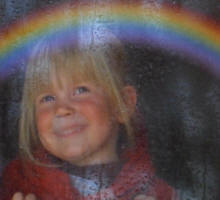
The Rainbow is the prequel of DH
Lawrence's Women in Love. Whereas the novel covers many
generations living through the industrialisation of North
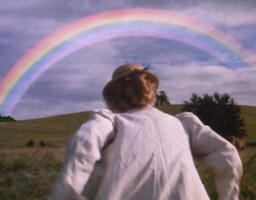
England, Russell focuses on the rites of passage of
Ursula from the child looking at the rainbow through to
her self-realisation. She calls herself "a bird
blown out of its own latitude".
 |
|
 |
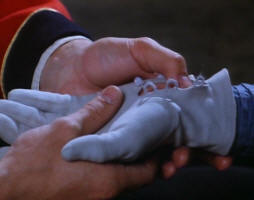
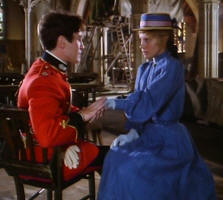
As a teenager Ursula meets the
dashing soldier, who almost seduces her in a
church, slowly peeling off her glove, reminiscent
of Brando picking up the glove in On
the Waterfront.
|
 |
|
 |
But he cannot compete with the
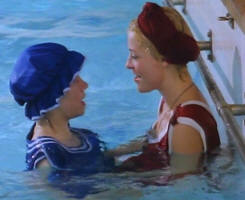
forbidden eroticism of the swimming instructor. Ursula
asserts her freedom by becoming a teacher, in a
Dickensian school, but it is an unhappy place as
she is caught between leering masters and
prank-playing children.
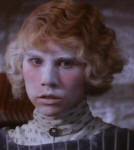
Discovering she is pregnant her only
hope seems to be with the soldier, but she
discovers he has since married. Caught
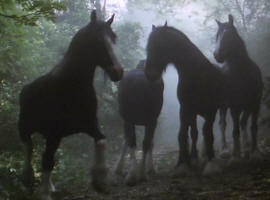
in a fog she comes across horses which terrify
her and she flees, the flight across a river
causing a fever which almost kills her. She wakes
at home, with her parents looking after her, and
a rainbow outside her window encourages her to
decide her future.
Russell uses many of the same
people, actors and technicians, who had worked on Women
in Love: Glenda Jackson and Christopher Gable,
cinematographer Billy Williams and George Cole, gaffer. The film company, Vestron, went
bankrupt just before the release, so the film had no
advertising whatsoever.
|
| people |
 |
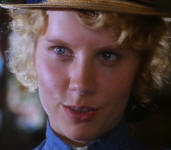
Sammi Davis
(Lair of the White Worm) stars. Amanda Donohoe,
also from Lair, has a major role. Both are good. |
 |
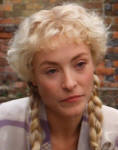
Glenda Jackson is superb
acting as the mother. She plays the part so naturally you
would never guess she is a double Oscar winning actress.
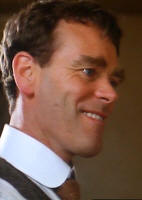
Christopher Gable is equally convincing.
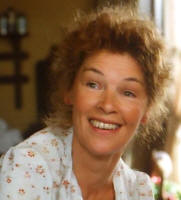
Molly Russell, Ken's
daughter and Rupert Russell, his son, play the children. Other regulars are David
Hemmings (Clouds of Glory), Judith Paris, Kenneth Colley
(Modeste in The Music Lovers). The music of Carl Davis
fits in well with film (for example the scene destroying
the cabbages), and Imogen Claire does the choreography. Photography was by
Billie Williams and Peter Davis was the editor. The book was adapted by
Ken and then wife Vivian Russell. The only weaknesses in
the script are the cursory references to
industrialisation, which should have been dropped, and
the confrontation with the horses where the symbolism is
not clear.
|
| best image |
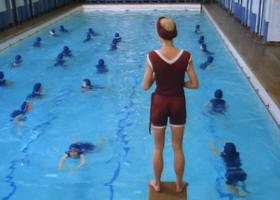
The rows
of swimmers like tadpoles...
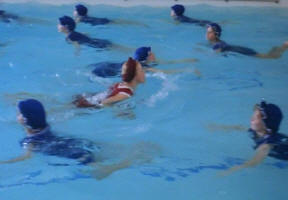
...and the lesbian lovers swim against the flow
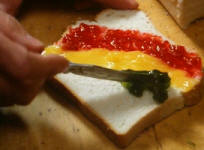
The rainbow
sandwich.
|
| best scene
|
The
lesbian seduction.
|
| themes |
 |
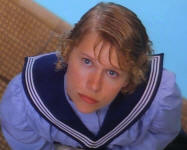
The
schoolgirls wear sailor suits.
|
The painter and his
model.
Sexuality (repressed, lesbian).
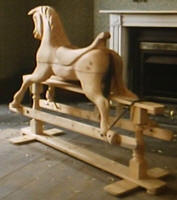
The rocking horse (A British Picture, Folk Songs) and real horses.
Hills and lakes.
Catholicism (various
church sequences).
|
| films |
Other films released in the same year include Born on the
Fourth of July, Black Rain and Driving Miss Daisy. |
| 1991 |
Whore
|
| |
A late gem by Ken Russell. Ken
experiments with actress Theresa Russell talking directly
to the camera.

She is sick of passing her
money to her pimp, and the film develops through
flashbacks. There are strong links to Crimes of
Passion, and some scenes are repeats of the
earlier film, but whereas Crimes of Passion
looked at sexuality, Whore is another rite of
passage film as the whore develops her
independence. This coupled with Theresa speaking
straight to the camera make it almost a one-woman
film. The mixture of whore and mother is also
more convincing than China Blue's dual life.


Although the film is Russell's third American
film (Altered States and Crimes of Passion went before)
it was originally firmly set in Britain, based on a play
by David Hines. The play, about a prostitute around the London King
Cross area, was a monologue which led to Ken Russell's direct-to-camera
approach.

The censored title is If
You Can't Say It, Just See It.

This was a censored version to be
sold in malls and supermarkets. The new title is crudely
placed over the original. It grossed over
$1m in America.
|
| people |
 |
Theresa
Russell is especially good
as the whore. She is no relation to Ken.
Ken Russell has a minor
role playing the head waiter. He also does
camerawork, credited as Alf Russell.
|
 |
Huggy Bear from Starsky
and Hutch appears.

Brian Tagg from Crimes
of Passion (as well as Bruckner and Prisoners of Honor)
edits.
|
| best image |
Theresa
Russell lying on a bench with her long hair falling down,
but filmed sideways so it looks as if she is upright and
her hair is straight out.

The phallic food.

|
| best scene
|
The pimp
trying to impress everyone and being put down by the
waiter and the violinist. The two girls talking together or
reading or watching a film with one falling asleep.

|
| themes |

There is a
film within the film.

One scene takes
place in a cinema showing The Lair of the White
Worm.

There is promiscuous
sexuality (compare Crimes of Passion), latent lesbianism
and violent rape (compare The Music Lovers).
|
| films |
Other films released in the same year include Silence of the
Lambs, JFK and Boyz N the Hood. |
| 1995 |
Mindbender
|
| |
If you are interested in bending
spoons this is one of the best films on the subject. The
life story of Uri Geller.
 |
The credits begin with "the
following events are true and are interpreted
through the artistic eye of Ken Russell". |
 |
Uri's father and lover dance on top of an
Israeli tank beside a 3-dimensional Dali-clock. The child
Uri pulls a bullet out of a wall (the six day war recurs
in the film) and when he holds it in his hand it turns
into a ring.

When his teacher tells Uri to
stay in class until the hands of the clock reach half
past four, of course young Uri has no problems moving the
hands and leaving early. But this sort of thing is really
banal and the films comes over as a paid-for vanity film
for Uri Geller
There is a silly spy plot and
Geller seems to save the world from nuclear war.
For the benefit of this page I
watched the film again. It does not improve with repeated
viewing. Also my watch stopped.
|
| people |
Ishai
Golan plays Uri Geller. A shallow insincere performance, so
probably true to life.
 |
Terence Stamp adds some
badly needed acting ability. Hetty Baynes seems to have
the role of an intelligent bimbo, and some genuine
intelligence comes over. |
 |
Music consists of
recordings such as Elton John's Rocket Man and The Moody
Blues Nights in White Satin, both of which fit well.
 |
Geller himself
also appears. If you buy the video it
will change your life since you can have your
broken watches and clocks repaired (just hold
them as Uri talks). Uri also wants to touch you,
so put your hand to the screen and touch his-
feel it!! Geller is not very convincing as he
pretends the rubbish is true. |
 |
Editors are
Xavier Russell and John Orland, cinematography is by Hong
Manley. The script is co-written by Ken and Yael Stern.
|
| best image |

The black
swings on the white beach, genuinely haunting images in
a boring film.
|
| best scene
|
The child
Uri eating soup when his spoon bends is reasonably funny.

The child Uri about to be beaten
and falling backwards among the tailors dummies.

|
| themes |
Fire. Uri
(in a dream) walks through a wall of fire over a
minefield.
 |
A
kite bursts into flame just like the hut in Mahler. |
 |
Sensory deprivation

|
| films |
Other films released in the same year include The English
Patient, Shine and Trainspotting. |
|