salad days Ken Russell had two false starts
in the cinema. French Dressing is sublime but was a
commercial failure so he retreated back to television.
Later he directed a Michael Caine thriller. This was a
commercial and artistic disaster and Ken was again out of
cinema.
| 1963 |
French Dressing
|
| |
Ken Russell's first cinema film
is dismissed by everyone including Ken, but it is a minor
classic. It is an innocent British story about a
deck-chair attendant who arranges for a famous French
film star to open the local film festival.
But actually the plot is an excuse for a
series of sketches centred around the hero and heroine,
with a rite of passage for both before they realise their
love is more powerful than their ambitions.
|
|
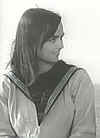
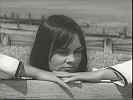
She is played by newcomer Alita
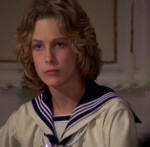
Naughton who is seriously cute, wearing a sailors
costume and looking like a female Tadzio from
Death in Venice- "the carnival is fancy
dress- come as a girl". The sailors costume
frequently appears in Russell films.
|
 |
The film is black and white and has all of Ken
Russell's eye for imagery. The editing and pace, and the
good non-professional acting, are similar to Dick
Lester's Beatles work. The film was scripted as a light
comedy, and the set jokes don't work, but this gives the
film a charm, as two innocents share the events that
unfurl around them.
|
| people |
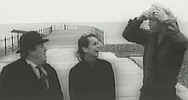
James Booth (right) and Roy
Kinnear, television actors, star. Alita Naughton is the
newcomer. Later she appears in Ken Russell's Isadora
Duncan television film. Ken met Alita when filming the
documentary Watch the Birdie about
photographer David Hurn, as she was then Hurn´s
girlfriend. Bryan Pringle, playing the mayor, also appears in The
Boyfriend, and Sandor Elés would later appear in Isadora.
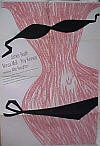
Shirley
Russell is costume designer. Cinematography Kenneth
Higgins (Elgar), Editor Jack Slade. The screenplay was by Peter
Brett who Russell chose because he knew him as an actor
from Elgar. Ronald Cass and Peter Myers also worked on the
screenplay, as well as on the similar Summer Holiday. Russell is credited as Kenneth Russell.
|
| best image |
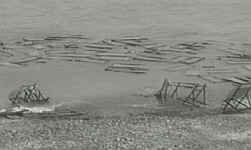
The deckchairs floating
face down in the water.
|
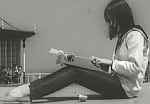
Closely followed by Alita on
the beach using her typewriter, framed into the entire
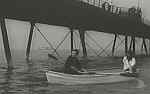
screen. Closely followed by the
rowing boat sailing under the pier. All highly visual
scenes.
|
|
|
| best scene
|
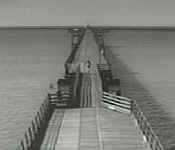
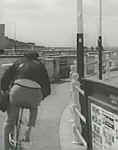
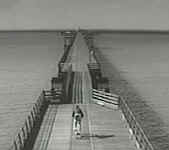
The opening sequence on
the pier. The courage of a newcomer to hold the shot as
the bicycle rides into the distance (David Lean edited
down his famous long shot in Lawrence of Arabia because
he thought the audience wouldn't take it).
|
| themes |
The elements water, fire, earth and
air (including lightning) play a central role in the plot.
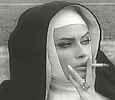
The French film star seems to escape disguised as a nun. She sits at the
railway station smoking a cigarette.
There is a film within the film.
|
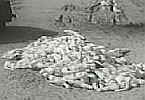
Wheelchairs and Holocaust (inflatable dolls)
|
 |
|
| films |
Other films released in the same year include My Fair Lady
(Oscar), Dr. Strangelove, A Hard Days Night and Mary Poppins. |
| 1967 |
Billion Dollar
Brain
|
| |
It could have been the start of
a wealthy career for Russell, his second film
commissioned by the James Bond producer Harry Saltzman,
story by novelist Len Deighton and with Michael Caine
starring in his third Harry Palmer role. But
the film shows little sign of talent, and you might be
mistaken in thinking Russell could make television but
not cinema. The pace is too fast with scene, location and
plot twist following relentlessly. It is Russell's only action
film apart from Dogboys.
|
There is some Bergman-like close photography of faces but it comes across as
pretentious. Michael Caine plays his usual
bespectacled detective/spy role without any
variation. |
 |
In the sauna wearing a large fur coat he
claims to be hot but he doesn't sweat. Awaking among a
pile of dead bodies (the people he had partied with the
night before) the feeling is of the inconvenience of
crawling out rather than revulsion or sorrow.

The plot concerns a computer (predictably the
billion dollar brain), eggs, taking over the world etc
etc etc. The computer will be used to help spread a virus,
but not a computer virus, the old fashioned human virus.

In the credits the title is also given in digits though the number is well above a billion (even above a
British billion) having 18 zeroes. The plot meanders from London to Finland and
to studio Russia and studio America. But the Finnish
locations are not used well and could just as well be
London. There is a rich Texan anti-communist General
Midwinter ("now is the winter of our
discontent") who wants to start a revolution in
Latvia. He has some of the phobias of anti-Communist
General Jack Ripper from Dr Strangelove (minor actor Paul Tamarin plays
in both).

The army on the move look more like a
group of people starting an expensive caravan
holiday, and the large cast often doesn't work: the
opposite of his television work- how to
make a large cast seem tiny. The coup fails when
Soviet planes bomb the ice and his army sinks under the water.
|
| people |
Russell regulars Vladek Sheybal
(Boyfriend, The Debussy Film etc), Alexei Jawdokimov (Isadora, The
Music Lovers) and Iza Teller (Christina Rosetti in Dante´s Inferno,
as well as Isadora and The Devils) have minor roles.
Stanley Caine (Michael's brother) has an appearance. Cinematography Billy
Williams, Editor Alan Osbiston. The writer is John
McGrath who also wrote Russell's Diary of a Nobody. It
is based on Len Deighton´s novel. In the novel the girl
is younger "she ran across the airport like a newly
born antelope unsteady on its legs". Original music is by film and
classical composer Richard Rodney Bennett. The piano is
especially effective. A Beatles song, A Hard Days Night, is also
used, one of the few occasions a Beatles song has been used in a film.
Copyright restrictions and costs may have caused difficulties
in re-releasing the film.
|
| best image |
 |
Children on a
Finnish windmill-like swing, black against a
frozen lake (Mindbender has a similar image on
the beach). |
 |
The woman in black
framed in the silhouette of a black house and tree. There
are various black and white images in this colour film. |
|
| best scene
|

Michael Caine traps an
intruder who has just picked up a packet of Corn Flakes.
"Put your hands up": as he does so the cereals
from the corn flake packet fall slowly to the ground. But
the scene is a bit too forced.

Caine squares up to the burly soldier
who strips for a fight, but it turns out he is only stripping for a
shower.
|
| themes |
The scene on the ice is
a homage to Eisenstein's Alexander Nevsky. The film is
mentioned in the novel.

The horsemen emerging
from a haze
in the white snow is similar to Dr Zhivago.
Russian
sailors wear their "Death in Venice" sailor
costumes.
A record in Harry
Palmer's room is the music of Berlioz, more the choice
of Russell than Palmer. The Russian commander meets
Palmer at a performance of Shostakovich's Leningrad
symphony.
There are numerous train
journeys including a steam train.

The computers are similar to those in Fritz Lang's
Metropolis (above).
The elements play a role, with
fireballs dropping from the sky, and ice turning to water.

The
holocaust imagery of the dead bodies in the bath.
There is a film within the film.
|
| films |
Other films released in the same year include Bonnie and Clyde
and The Graduate. |
|