home films tv biog best scene shop news discussion download interviews more all the sites русский

KenRussellfilms


cashing in

When Russell did the Who's Tommy he suddenly had a major commercial success on his hands. Disappointingly is was followed up by a cash-in movie, and box-office failure of Valentino removed his commercial tag.


1975

Tommy

  Pete Townsend's rock opera, with some of the scenes shifted to makes some sense of the plot.
Ken Russell Tommy

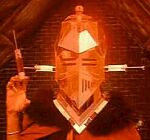
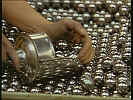
The story concerns a child who witnesses his father being murdered by his mother and lover. His mother (who works in a ball-bearing factory) tells him not to tell what he saw or heard, so he becomes deaf, dumb and blind. He does have one gift, he can play pinball. The pinballs are identical to the ball-bearings from his mother's factory, and to the device later put in his eyes at the instigation of the doctor, Jack Nicholson. Tommy becomes a messiah figure to his followers until they realise they also have to become deaf, dumb and blind.

The film is based around an LP. It was becoming fashionable to produce theme LPs and Pete Townsend surpassed most by coming up with a story line (even if it at times does not fit). The story is inspired by the blues song Eyesight for the Blind by Sonny Boy Williamson, with the most famous song Pinball Wizard added to ensure there was a hit single.

The film is a series of visual images.

Ken Russell Tommy

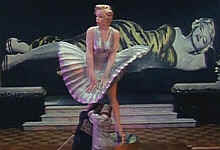
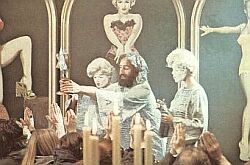
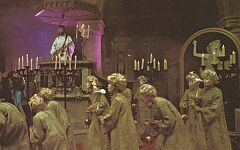
In the church Marilyn Monroe replaces the Virgin Mary.  Under her statue blondes in Monroe masks give the sacrament of whisky and pills.

Ken Russell Tommy

Ken Russell Tommy

But she turns out to be a fallen idol.

Ken Russell Tommy

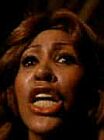
Tina Turner in Tommy

Tommy rejects this religion, and Tina Turner's attempt to awaken his senses with sex and drugs also fails. "If your child ain't all he should be now, this girl will put him right. I'll show him what he could be now, just give me one more night". Ken Russell Tommy

Tommy emerges and becomes the new messiah with a mass following.
His parents exploit this.

Ken Russell Tommy Ken Russell Tommy Ken Russell Tommy Ken Russell Tommy

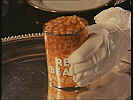
The scene is based on the Who's LP "The Who Sell Out" where Daltry appears eating Heinz Beans etc to attack commercialism. Russell himself did advertisements for baked beans and soap suds (in his advert, to show how the soap suds simply disappeared down the sink he filmed the suds being pumped into the sink then reversed the film).
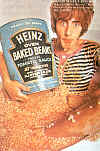
The Who


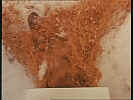
  During the film there were a number of accidents. Ann-Margret cut herself while filming the soapsuds episode (turning the suds red).  Ann-Margret says "my hand went to the TV screen and the cut glass sliced into it.  Dripping with blood I was quickly wrapped in a blanket and carried off the set, and then rushed to the hospital, where doctors took twenty-seven stitches to close the wound... [then] I shot a scene with my arm hidden under a table".

Daltry underwater almost drowned before the crew realised he was in trouble and dived in to help him.  Daltry burnt himself when running through the fire and the later takes show him holding his injured arm.
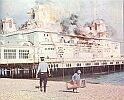
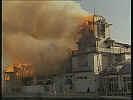
Southsea pier fire Most spectacularly when filming on Southsea pier a fire broke out seriously damaging the pier.  Ken used film of the real fire in part of Daltry´s running through fire sequence. Ken Russell Tommy
people The Who obviously appear. Roger Daltry is Tommy and fortunately he does not speak for most of the film. Apart from Daltry, Keith Moon is the only acting Who member, relishing his role as the child molesting Uncle Ernie.

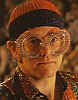
Other rock stars such as Elton John (Pinball Wizard) and Tina Turner (the Acid Queen) are spectacular in their video segments. Elton John was a possibility for a role in Ken Russell's Rainbow before he chickened out.
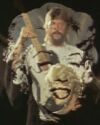
Clapton in Tommy with a Monroe image Eric Clapton (left) was too drugged out so Arthur Brown was brought in to make the scene more interesting.  Oliver Reed appears as the Father, Ann-Margret as the mother (she was nominated for an Oscar for the role). Jack Nicholson is the doctor.  Ken Russell's daughter (right) plays Sally. Sally Simpson in Tommy

Editing is by Stuart Baird. Cinematography is by Dick Bush and Ronnie Taylor. Costumes are by Shirley Russell.  Ken used in total a crew of 88. Tommy cost $2 million and took 22 weeks to shoot.
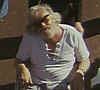
Ken Russell in Tommy
Russell can be seen in a wheelchair in one scene.


best image

Ken Russell Tommy
The church worshipping Marilyn Monroe with the row of Marilyns walking down the church aisle.
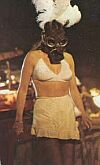
Ken Russell Tommy
Dancers in gas masks in the London blitz sequences.  The war sequences were originally going to be black and white.
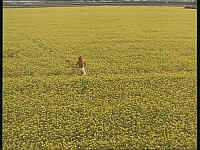
Ken Russell Tommy
Running through the fields.

best scene
Elton John in Tommy Elton John's pinball wizard

and

Tina Turner's Acid Queen. Tiny Tim was the original choice for the part.

Ken Russell Tommy
 
themes Tommy has a lot of references including to Ken's BBC days (the waterfall sequences) as well as to Mahler (Robert Powell and the rocks). The train scene is similar to Fenby´s arrival in Delius, and the blind and paralysed Delius is a proto-Tommy. The mirrors with the young child could be from Bartok, the corridors remind you of the convent in The Devils.
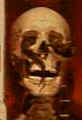
Ken Russell Tommy
There are snakes crawling on a skeleton.

Daltry appears in a number of Christ images including crucifixion, walking on water, and walking on the beach with the fishermen (I will make you fishers of men).
Ken Russell Tommy
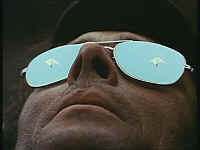
He descends on Hells Angels from the air (a heavens angel), here reflected in the glasses.
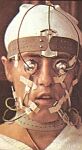
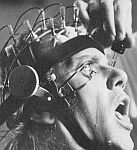
Ken Russell Tommy The "cure" imagery is similar to that in Kubrick´s A Clockwork Orange. A Clockwork Orange
films Other films released in the same year include Star Wars, Annie Hall and The Spy Who Loved Me as well as Russell's Lisztomania.


1975

Lisztomania

  A film on Liszt with music by Rick Wakeman. Says it all. Not Russell's idea.

Ken Russell Lisztomania

A Golem/Frankenstein creature (Wagner, killed by Liszt and resurrected by his daughter Cosima) with an electric guitar that is actually a machine gun walks through a ghetto slaughtering Jews, accompanied by children wearing superman-like clothes. Cosima sees a face through a swastika-shaped window and pulls out a voodoo doll and pierces it with a pin to kill the person. Yes, clearly the story of the composer Liszt.

Roger Daltry in Lisztomania A cheap looking cash-in on Tommy, though Russell says it cost over a million pounds- one of his highest budgets. Roger Daltry´s acting is especially poor even for him. Ken Russell Lisztomania

It is basically a sex comedy though it is not very funny. The concert sequence with squealing girls dressed like Jane Austen is too long and the film collapses into banality.

Ken Russell Lisztomania

Typical of Russell, there is a basis in truth. The worst element is the pretentious modern title Lisztomania- but this is actually the title of a book published in Liszt's time.

Ken Russell Lisztomania

Another view by site visitor Steve Mobia (thanks Steve) is:

"A constant stream of visual imagination, LisztOmania is the most unconventional and unique of Ken Russell's output.

Ken Russell Lisztomania

Whereas the films of Mahler and Tchaikovsky had flashes of brilliance (the 1812 overture scene in The Music Lovers, the conversion scene in Mahler for instance), with Liszt, Russell finds the freedom for full unhinged expression. It must take the cake as the most peculiar biography ever made about a classical composer. The real world Liszt was a master show off, turned the keyboard toward the audience and performed diminished seventh runs as if possessed by the devil. Russell's film depicts Liszt as the first classical "pop star," complete with fanatical pubescent fans (with fans) and groupies. The movie darts in and out of music and film references, historic fact and allegory — all presented in a hyberbolic comic strip fashion. Yes it's often tasteless and crude but that's all a part of the fun.

Ken Russell Lisztomania

Though The Devils is arguably Russell's greatest film in both structure and substance, LizstOmania, though not a very well structured movie is dazzling in its audacity. The picture is a must-see for any music student!"


people Roger Daltry as Liszt, Ringo Starr as the pope, Rick Wakeman doing the music as well as acting. What more could you want. An example of the lyrics "war is waste, waste is guilt".  Oliver Reed appears in a cameo role as the servant.

Roger Daltry in Ken Russell Lisztomania

Stuart Baird edits and cinematography is by Peter Suschitzky.  Shirley Russell does costumes.

best image Daltry, in love, writing music notes as hearts.

Not an image but a piece of dialogue, obviously Russell's- "time kills critics my dear".

Two of the Russian icon paintings of saints are actually paintings of Elvis and Pete Townsend.

Ken Russell Lisztomania

best scene

Ken Russell Lisztomania
the Chaplin sequence


themes Wagner appears in a sailor's suit (French Dressing etc).

The tsarina is similar to the doll in Gothic.

Ken Russell Lisztomania
Daltry in his skimpy loin cloth is often a Christ image

films Other films released in the same year include Star Wars, Annie Hall and The Spy Who Loved Me as well as Russell's Tommy.


1977

Valentino


Ken Russell Valentino

A biography of the silent film actor Valentino ("The Four Horsemen of the Apocalypse"). The film starts with Valentino´s funeral and the mass hysteria at the time, then continues as a series of flashbacks in the style of Citizen Kane.

Ken Russell Valentino

Valentino is a club dancer who gets in trouble with the mob and with the entertainment industry. His foreignness is used against him (whoever heard of a dago playing a dago) and his appeal to women causes resentment and allegations of homosexuality. His reputation grows as a cinema star and as a lover. Women adore him but continually men insult him (pink powder puff).

Finally he is tricked into a boxing match with a journalist who turns out to have been boxing champion in the marines.

In genuinely exciting scenes Valentino is continually pummelled to the ground, till eventually his opponent grabs him, barely conscious, and dances him round the ring. He is only saved by the bell.

In true Rocky fashion after the bell Valentino comes out and unexpectedly has found strength and turns the fight round, grabbing his opponent and dancing, up to the knock-out. Valentino has saved his honour.

Ken Russell Valentino

At his funeral an actress comes to his coffin and faints. The cameramen have missed it, so she revives, goes to the coffin again and faints again, this time front page news.

The film is edited well with fast pacing but a good control of the story. It is however too long, 30 minutes shorter would improve it.

The imagery is good.

Ken Russell Valentino Ken Russell Valentino Ken Russell Valentino

The film was a major commercial failure.

people Nureyev stars but he is not really an actor and probably his ego stopped him giving up totally to Russell's direction. He starts well but the film is a bit too long and the accent starts to grate. He was originally brought in to play the small role of the dancer Nijinsky.

Cinematography is again by Peter Suschitzky and editing by Stuart Baird. Shirley Russell does the costumes.

The script is by Russell and Mardik Martin, who also contributed to Mean Streets, New York New York and Raging Bull for Scorsese.  The basis is a pulp fiction biography of Valentino by Brad Steiger.  An example of Russell's vision is the scene at the beginning of the book and film where the screaming fans break through the glass of the funeral parlour.  In the book the windows are then boarded up with planks of wood.  Russell's film changes the planks of wood to coffin lids.

Lindsay Kemp the dancer plays the mortician.

Ken Russell Valentino
Russell appears briefly as the director

best image Boarding up the broken windows with coffin lids.

The vulture on a stone in the desert filming scene.

best scene

When Valentino gets revenge by seducing in a dance Mr Fatty´s girl.

Ken Russell Valentino

When the mobster beats up Valentino and the girl shoots the mobster. Three scenes developing the plot pass in ten seconds.

themes The film is framed in a Citizen Kane structure, starting with newsreel footage and an exquisite performance, the film progressing in flashbacks that tell the story, and ending with Valentino collapsing and an orange rolling away, Rosebud fashion.

The period fans in the cinema are identical to those in Lisztomania. There is a very unconvincing madhouse scene which is a cheap copy of Glenda Jackson's harrowing scene in The Music Lovers.

Ken Russell Valentino

The child wears a sailor costume.

Ken Russell Valentino

There are films within a film, as well as the childrens swing.

.Valentino film within a film

films Other films released in the same year include Star Wars, Close Encounters and The Spy Who Loved Me.


More films

click for previous films click for films index click for next films


home films tv biog best scene shop news discussion download interviews more all the sites русский

www.savagemessiah.com
send mail