|
the classic
period 2
As
a change of pace Russell did a lighter piece, The
Boyfriend. This was a commercial failure. He then
completed his most autobiographical film, Savage Messiah,
funding it with his own money, another failure. With two
flops he needed a commercial success, so returned to
classical composers with Mahler.
| 1971 |
The Boyfriend
|
| |
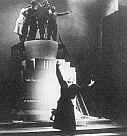
Rather than film the musical The Boy Friend,
Russell made the film about the making of the musical.
When the star of a show breaks a leg, the newcomer,
Twiggy, has to take her place. A major film director
comes to look at the show as a possible new film.


The film was badly cut by the studio before
release. Russell himself says (The Lion Roars) "but
twelve reels are too long to tell such a slim tale, and
Sandy Wilson's music, however tuneful, has diminishing
returns, as one pastiche Twenties number follows
another". The imagery however is stunning.

It was filmed in Portsmouth in the Theatre Royal. Russell
wanted to film in a theatre rather than a film studio. In
a case of reality imitating art, as preparation Russell
and Twiggy went to an amateur production of The Boyfriend
in Essex and they caused the same reaction as in the film
with the famous director visiting the amateur production.

|
| people |
Twiggy is a
film newcomer putting in a good performance as
the stage newcomer. Glenda Jackson appears
uncredited as the overshadowed ageing star. It was one day's work.
Christopher Gable is the male star.


Barbara Windsor
of the "Carry On" films appears.
Russell wanted her to play differently from her
usual image, but she didn't. Peter Maxwell Davis
again provides the music. Photography is by David
Watkin. Regulars are Michael Bradsell (editor) and
Shirley Russell (costumes). Ken also did the screenplay. The film cost $750,000.
|
| best image |

The
dance sequences in Busby Berkley style are
spectacular. |
| best scene
|
Glenda Jackson telling
the audience to be quiet as they clap the new star
Twiggy. |
| themes |
Twiggy initially
appears in a sailor's costume. The innocent relationship of Twiggy
and boyfriend.
|
| films |
Other films released in the same year include A Clockwork
Orange, The French Connection and two more Russell films- The Devils
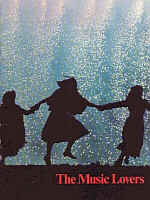
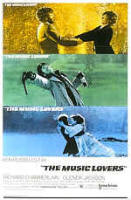
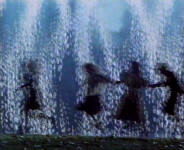
and The Music Lovers. |
| 1972 |
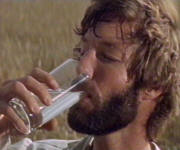
Savage
Messiah
|
| |
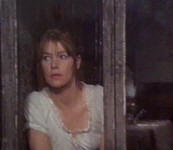
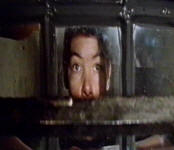
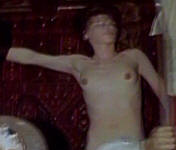
Moving from music to sculpture
Russell comes up with one of his cult masterpieces about
Henri Gaudier.
Gaudier meets the much older and prim Sophie
Brzeska. They develop a friendship leading to them
sharing names (Gaudier Brzeska) though they never
married. Ken Russell's imagery is as always breathtaking.
In one of Russell's best scenes Brzeska waits
for Gaudier at a station.

The train comes and goes but no
Gaudier. Another train leaves and there is Gaudier on the
wrong platform, arms full of roses for Brzeska. He runs
towards her, jumping from platform to rails. He slips as
a train emerges but rather than escape the train he picks
up the roses, at the last moment avoiding the wheels of
the train and falling into Brzeskaīs arms.

Gaudier joins the war. The superb line "I
have succeeded in making the enemy angry..." is a
true letter quoted in H.S. Edeīs biography of Gaudier.
The film ends, just as Edeīs book does, with Gaudierīs
work.
 |
Gaudier could be seen as Russell's
fictional autobiographical character. When
Russell read H.S. Edeīs biography he was the
same age as Gaudier "I was impressed by
Gaudierīs conviction that somehow or other there
was a spark in the core of him that was personal
to him, which was worth turning into something
that could be appreciated by others."
Russell also says (Films and Filming Oct 1972) "I wanted this
film to be totally different from the big companies and back
into the small studio, back to the BBC sort of style with a
small unit". |

|
Alex Russell, Ken's son, who plays a role in
the film, says
"On Savage
Messiah, I remember when filming on the sea coast some
oil or tar was on the lens of the 35ml camera; but was
not discovered till the evenings rushes screening: so a
whole days shooting was ruined! Also: the rain seen was
done via the fire brigade pumping salt water straight
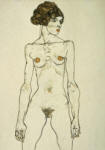
from the sea! Also: the Gaudier Breshka charcoal and
pastel drawings (well faked) for the film were later
stolen and sold as originals down Bond Street and at
Sotheby's!"
|
| people |
Scott
Antony plays the sculptor and Dorothy Tutin his mistress.

Helen Mirren appears in
one of her first film roles.
Photography is by Dick
Bush. Editing is again by Michael Bradsell and costumes
by Shirley Russell. Derek Jarman provides the sets.

The dancer/choreographer
Lindsay Kemp makes an acting appearance.
The film was largely
self-financed by Russell which made its commercial
failure a particular blow.
|
| best image |

The opening
credit sequence with Gaudier drawing the bones of a hand,
the pen scraping the paper.

|
| best scene
|
The last
but one major scene with the talking heads cut with the
dancer. The perfect mix of loud music, sharp cutting and
glaring colours.
 |
The
last major scene where Russell simply shows the beauty of
Gaudierīs sculptures. The Edinburgh Museum of Modern Art
has a room of Gaudierīs work including many of the ones
Ken Russell shows. |
|
| themes |
In one
scene it appears as if Gaudier will be killed by a train. The victory celebrations are very
similar to those in Tommy.
The scene with a general
in full uniform on a horse inside a room being painted is
revived in Prisoners of Honor with the officer in Roman
dress.

 |
Gaudierīs
studio (left) is almost identical to the workers
area in Fritz Lang's Metropolis (right). |
 |
|
| films |
Other films released in the same year include The Godfather
and Lady Sings the Blues. |
| 1974 |
Mahler
|
| |
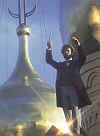
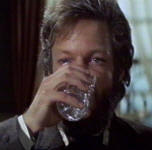
A film about sacrifice and
creativity. It starts with a dream sequence which
is Russell at his best and most kitsch. A
train journey provides a rite of passage. Mahler
remembers episodes from his life, and on the
train itself he confronts jubilant crowds
(success), the gutter press (sensationalism), his
wife's lovers (infidelity), and the doctor
(mortality).

A beautiful film mixing true emotion, the
death of Mahler's children, with dancing Nazis.
At times Powell seems to be influenced by Dirk
Bogard from Death in Venice with the similarities going
beyond the direct homage included in the film.
The domestic sequences of Mahler as a child
are similar to those in Savage Messiah.
The film cost just over 150,000 pounds and was
shot in seven weeks. The American version was shortened by 30
minutes, mainly by removing the Cosima Wagner sequence.
|
| people |
 |
Robert Powell
plays Mahler and Georgina Hale his overshadowed
wife Alma who literally buries her creativity. |
 |
Oliver Reed appears in a
cameo role as the railway guard. Dana Gillespie the
singer (she recorded Bowie's Andy Warhol before Bowie did)
plays Mahler's mistress, and she wrote the composition
she plays. Photography is by Dick
Bush.
|
| best image |

The hut by the lake bursting into flames
|
| best scene
|

Alma Mahler
walking down the stairs in a black veil like the shadow
of death
|
| themes |
Ken Russell
includes a homage to Death in Venice.
There is a long train ride.
Various nuns.
A crucifixion
with Nazis etc. Russell kitsch at its best.
The scenery is around
Russell's home in the lakes.
Mahler makes fun of
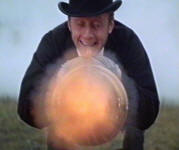
Tchaikovsky's piano concerto just as in The Music
Lovers.
|
| films |
Other films released in the same year include The Godfather 2
and Towering Inferno. |
|