| |
Altered States fom 1980, another shift as Russell tackles
science fiction.
 |
Russell claims the film was first
offered to Spielberg, Kubrick, Sidney Pollack,
Robert Wise, Welles, Scorsese, Fred Zimmerman,
Woody Allen, Ingmar Bergman, de Palma,
Bertolucci, Boorman, Tarkovsky, Irwin Kirshner,
Coppola, Polanski, Dick Lester, Michael Winner,
Sidney Lummet, Dick Donner, George Lucas, Roeg,
Schlesinger, Truffaut, Zeffirelli, Bryan Forbes
then Ken Russell. |
 |
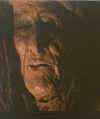
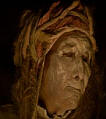
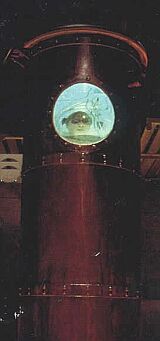
The story concerns Dr Jessup, a
university scientist experimenting with sensory
deprivation causing hallucinations.
He
complements his experiments with a visit to
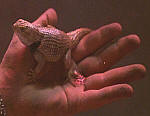
Mexican Native mystics and the potion he drinks
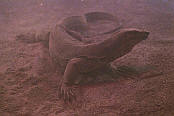
later combined with his experiments cause Hurt to
regress to a Neanderthal creature who´s only aim
is to eat, drink, sleep and survive.
A plot driven film with a weak
sub-plot of love conquering Faustian ambition
"you are a Faustian freak, selling your soul
to find the great truth".
The dialogue in the film is at times like the
worst (whining) of Woody Allen´s man-woman self-confessionals. This may
reflect Russell's emotions after his own divorce, but the fault lies
mainly with scriptwriter Paddy Chayefsky.
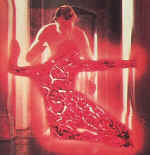
There are too many messages (Faust and selling
one's soul, primeval origins, the essence of soul etc etc) which
conflict with the too busy imagery of psychedelic journeys and bodily
transformation.
 |
The pacing is also faulty. The
psychedelic images come very early, and the
Neanderthal creature is shown the moment he
emerges, so at the end of the film there are no
surprises left, rather just repetition of
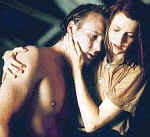
effects. There is a lot of sentimentality with
gushing violins "if you love me we can fight
it", only occasionally is there some sharp
writing- the student girl in bed still calls her
lover Dr Jessup. |
 |
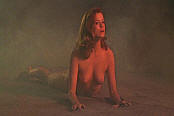
But despite its weaknesses it does often
succeed and demonstrated that Russell could turn out
mainstream Hollywood successes. The hallucinations are
stunningly beautiful.
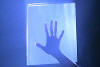
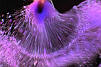
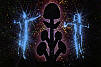
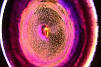
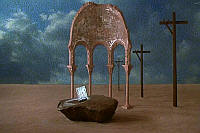
The influence of Dali.
He could have developed a career as a sci-fi/
horror director but turned down later sci-fi scripts to
avoid being typecast. If the film was 20 minutes shorter,
with most of the family scenes omitted, it would be a
classic.
The budget was $9 million which rose to just under $15
million. After shooting there was a 10 month period of special effects
production.
|
| people |
William
Hurt stars, his first film. Blair Brown plays his wife
who is supposed to be as much a genius as he is, but her acting never shows it.
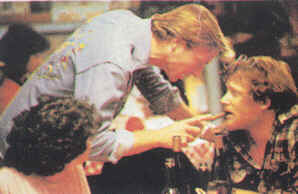
Drew Barrymore is the
small daughter.
Music is by classical
composer John Corigliano. It was his first music for film
and he later won the oscar for his music for The Red
Violin. The music is at times extremely effective, for
example in the cave sequences.
The editor is Eric
Jenkins and photography is by Jordan Cronenweth. SFX are
by Brian Ferren. The film is based on the novel by Paddy
Chayefsky with the script by Sidney Aaron- a pseudonym
for Chafesky adapting his own novel- he wanted to
disassociate himself from the film. Assistant to Ken
Russell is Vivian Jolly, his later wife.
|
| themes |
The
sensory deprivation follows on from the blind Tommy and
paralysed Delius. In
the hallucination sequences a snakes wraps itself around
Hurt´s neck. There is a whole field of crucifixions and
various other devil/ crucifixion scenes. The elements,
fire, earth, water and air, feature heavily.
The native Indian scenes
are on mountains not too dissimilar to Russell's British
mountain scenery.
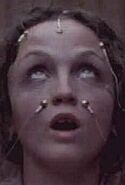
There is a television
within the film of a girl with electrodes in the
laboratory. The images are very similar to those of Linda
Blair in the hospital in The Exorcist. She later appears
in a wheelchair.
Similarly the old
laboratory could be the rusting ship of Alien, the father
in the bed comes from Song of Summer and 2001 A Space
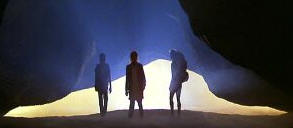
Odyssey and the entrance to the cave is similar to the
climax of Close Encounters. The Indian imagery is at
times similar to Kenneth Anger's Inauguration of the
Pleasure Dome. The creature awakening as human in the zoo
is identical to the later American Werewolf in London.
Lots of shots of William
Hurt silhouetted down a long corridor, significantly just
before he meets his wife, and just before the final
transformation leading to reconciliation.
The old laboratory has a
pile of tailors dummies, lumped together like dead
bodies.
Hurt kneeling naked
beside his future wife after their lovemaking is the same
image as in Valentino.
|