We performed the play on a hot Sunday night and
it lasted more than four hours. On Monday the papers were raving about
it...it all happened so fast the government couldn't do anything about
it
(interview by Alisa Solomon, Theatre, Winter 1982)
Theatre in the making. Zakes Mokae and Athol Fugard at the beginning of their careers in apartheid South Africa. International success also encouraged Mokae to escape apartheid and move to the London stage.
Athol Fugard No Good Friday 1958
Fugard´s first significant play No-Good Friday in 1958. Performed in Johannesburg with Fugard as Higgins and Zakes Mokae as the thug. For a performance to a segregated white audience Fugard (the only white role) was replaced by a black actor.
"Mokae struck Fugard as ideally suitable for a thug, a small role he gave him in No-Good Friday, in which he plays one of Shark's sidekicks. Fugard recalls a growing sense of Mokae ´being a very special person´, which led him to write the role of Blackie, Queeny´s crippled and violent hanger-on in Nongogo, especially for him" from Dennis Walder´s Athol Fugard.
In Russell Vandenbroucke´s Truths the Hand Can Touch, he
states that Mokae was to play Shark, but had to leave to
attend a funeral, and when he came back was given the
role of the thug. Sheila Fugard in Twentieth
Century Literature says "Zakes Mokae, who had just
turned twenty, and hardly ever spoke, was Athol's choice
for the role of 'first thug'.
Athol sensed the acting potential of this young man, who had been a protégé of Father Trevor Huddleston, an English cleric who was a political activist in Sophiatown. Zakes had been a member of Father Huddleston's jazz group. He was withdrawn, yet behind his shy grin he was able to project an undertone of menace. No-Good Friday was the beginning of Zakes's career".
The image is from here.
Athol Fugard Nongogo 1959
Athol Fugard´s early play was performed in 1959 in Johannesburg with Zakes Mokae as Blackie. Nongogo is slang for a cheap prostitute.
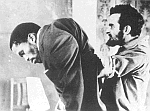
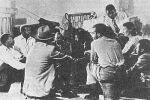
Mokae says "I met Athol in the 50s...I was playing the saxophone in those days. Somehow we got around to doing some plays just for the fun of it and because we believed in it. We... did plays about the ghetto- Nongogo and No-Good Friday. The actors were not only acting, but also finding the props, building the scenery, doing whatever needed to be done. I think it was there that Athol developed his style of writing for small casts in one location. He wouldn't write for a lot of people because half the time they weren't going to show up".
Mary Benson in Twentieth Century Literature says "Fugard cast Mokae as a township thug in No-Good Friday, and then wrote the role of Blackie, Queenie's crippled and violent hanger-on in Nongogo, especially for him, and this, Fugard said, "was the start of one of the really rich working relationships of my life". Photo left of rehearsal of Nongogo from Stephen Gray´s "Athol Fugard", Photo above of Fugard rehearsing Mokae in Nongogo from Walder´s "Athol Fugard".
Harold Pinter The Dumb Waiter 1961
Harold Pinter's play, as part of the Rehearsal Room days in 1961 with Athol Fugard.
Listed in Mokae's biography in programme notes for Fingernails Blue as Flowers.
Samuel Beckett Waiting for Godot
Beckett's most famous play directed by Athol Fugard.
Listed in Mokae's biography in programme notes for Fingernails Blue as Flowers.
Samuel Beckett Krapp's Last Tape
Beckett's solo piece as an ageing Krapp is confronted with his younger self. Also directed by Athol Fugard.
Listed in Mokae's biography in programme notes for Fingernails Blue as Flowers.
Athol Fugard The Blood Knot 1961
Fugard says this was the first play, in 1961, in which he discovered his voice. It was his first international success with himself and Zakes Mokae playing the two roles.
Two brothers, both are ethnically black but one could pass for white. The "white" one has written a letter to a white girl who will visit him. Gradually the fear of her visit takes over. The two are a metaphor for South Africa and the separate races. Zakes´ character is called Zak (almost his own name). The play lasted for 3-4 hours and when Mokae and Fugard forgot the lines they would ad lib during performances.
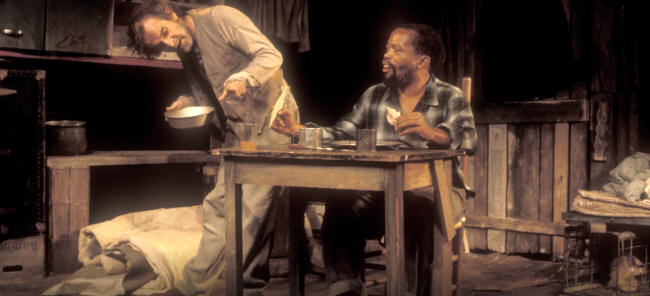
Mokae and Fugard. The photo is by William B. Carter from here.
Fugard says "Zakes Mokae... who paid some very heavy prices for working for me. I mean there were days when I literally had to cradle his body because he had been beaten up... beaten up and kicked around by policemen" (from Fugard talk at Signature Theatre production of Blood Knot, 2o12).
J.A. Brown Angel Feathers on the Roof
Performed in Johannesburg and then London in 1962. Mokae directed. See entry under Theatre in London, 1960s on the next page.


