|
Sarah Kane plays are
available in shops and libraries.
You can also buy them from Amazon in America or Europe.
They are
not available for downloading.
|
| Plays |
USA |
UK/Europe |
The
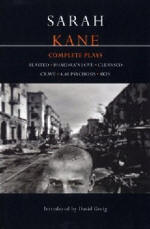
Complete Plays
The five plays plus the script of the television film
Skin. There is also a good introduction by David Greig:
"it would be natural for the reader to question the
practicality of staging the work. This is the question
that goes to the heart of Kane's writing. Every one of
her plays asks the director to make radical staging
directions, whether it is how to represent violence in Blasted,
how to represent rats in Cleansed
or what visual context to give the voices in Crave.
In a Kane play the author makes demands but she does not
provide solutions" |
 |
 |
Blasted
Blasted and Crave are good places to start. |
 |
 |
| Phaedra's Love |
 |
 |
| Cleansed |
 |
 |
Crave
Blasted and Crave are good places to start. |
|
 |
| 4.48
Psychosis |
 |
 |
| Criticism |
USA |
UK/Europe |
| 'Love me
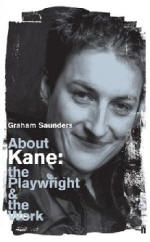
or kill me': Sarah Kane and the Theatre of Extremes by
Graham Saunders. Highly
recommended. The book in in two
sections, the first covering each of the plays:
| "Crave and 4.48 Psychosis
are... both noticeable in their disregard of setting.
Whereas in her previous plays Kane had been very particular
about providing details of location, such as the ´expensive
hotel room in Leeds´... the spaces which Crave and 4.48
Psychosis inhabit more closely resemble mindscapes which the
director and/or designer are free to conjure with." |
and the second featuring interviews
by Saunders with Kane directors James Macdonald and Vicky
Featherstone, Nils Tabert, Mel Kenyon, Phyllis Nagy, Kate Ashfield,
Daniel Evans and Stuart McQuarrie. From the interview by
Saunders of James Macdonald:
"Saunders: The use of
specifying rain through a spectrum of different seasons seems
to give the play a further surreal quality- of time slowed
down like one of Cate´s fits.
Macdonald: The sense of altering time scale also
relates to the use of alternating darkness and light once Ian
has been blinded..." |
 |
207 pages with photos. |
|
 |
 |
| In-Yer-Face
by Aleks Sierz Young
British playwrights. 32 pages on Kane. A good
biographical overview
On Cleansed: "In a
play about love, each of the four main relationships is
different and symbolic. Grace and Graham represent the
fantasy of incestuous, identity-sharing twins; Carl and
Rod are the classic couple, one member of which is
idealistic, the other realistic; Tinker and the dancer
represent domination and alienated love; Grace and Robin
experience a teacher and pupil, mother and child rapport.
In each case, the relationship is difficult and makes
suggestive assumptions about gender and identity: Grace
becomes Graham without ceasing to be female, Carl and Rod
are the same sex but have the opposite sensibilities;
Tinker has the power to abuse the dancer, but she's
complicit in her victimization; Robin is needy and falls
in love with care and knowledge, which kill him"
Highly Recommended.
|
 |
 |
Drama +
Theory: Critical approaches to modern British drama
by Peter Buse"Each chapter pairs a well-known play
from the post-war period with a classic theory text." One chapter, 19 pages, is
"Trauma and testimony in Blasted: Kane with Felman"
"...there are good reasons to
assume that not everything that occurs on stage happens at the level
of a single ´reality´ but that at least some aspects of the civil
war raging outside the hotel, and the arrival of the soldier, are in
fact phantasms of Ian's memory"
Other chapters cover
Osborne, Pinter, Stoppard, Orton, Griffiths, Churchill,
Hare and Wertenbaker.
|
 |
 |
| The Full
Room by Dominic Dromgoole How the dramatic works of the
1990s have shaped the New British Theatre movement. As
well as Sarah Kane playwrights discussed include Billy
Roche, Sebastian Barry, Conor MacPherson, David Harrower,
Jonathan Harvey, Philip Ridley, Richard Cameron and Naomi
Wallace.
Some good writing (five
pages) on Kane:
"The only problem
with Sarah, in my view, is that I'm not sure she's a
natural writer. The sturm und drang
and the savagery; the shitting and the fucking; the
deconstruction and the erudition, the whole feast that's
on offer tends to distract from the lack of simpler,
quieter virtues. Relaxed human dialogue; characterization
that is vivid, surprising and true; the creation of
worlds both recognizable and new; narrative lines that
both support and surprise; a fidelity to life- all these
virtues are harder to find in Sarah's work"
|
 |
 |
Live 3:
Critical Mass by David Tushingham
|
An
introduction to writers who are helping to shape the
future of the British theatre. Sarah Kane is represented
by 11 pages from Blasted.
The five line biography includes "Her monologues
Comic Monologue, Starved and What She Said have been
performed by Fringe companies throughout Britain". |
Kane is quoted as saying
"If a play is good, it breathes its own air and has
a life and voice of its own. What you take that voice to
be saying is no concern of mine. It is what it is. Take
it or leave it".
Other pieces are Patrick
Marber's Dealer's Choice,
Jonathan Harvey's Beautiful Thing
and Philip Ridley's Apocalyptica.
The photo from the book
is by Simon Annand.
|
 |
|
| Rage and
Reason by Heidi Stephenson and Natasha Langridge Interviews with women writers,
including Sarah Kane just after Phaedra's Love. A six
page interview, plus interviews with 19 other women
playwrights such as Pam Gems. Kane says:
"There was
something about the inadequacy of language to express
emotion that interested me. In Phaedra's Love, what
Hippolytus does to Phaedra is not rape- but the English
language doesn't contain the words to describe the
emotional decimation he inflicts"
"Blasted raised the
question ´What does a common rape in Leeds have to do
with mass rape as a war weapon in Bosnia? And the answer
appeared to be ´Quite a lot`. The unity of time and
place suggests a paper-thin wall...A wall that can be
torn down at any time, without warning"
|
|
 |
| Jack Tinker, A Life in Review by James Irverne,
1997 A tribute to critic Jack Tinker. It
includes his infamous review of Blasted This disgusting piece of
filth:
"...For utterly
disgusted I was by a play which appears to know no bounds of decency yet has no
message to convey by way of excuse... utterly without artistic merit...".
|
 |
 |
| Criticism- reference works |
|
|
| 20th
Century Drama by Stephen Unwin and Carole Woddis A general overview of theatre,
looking at 50 significant plays.
Blasted is covered (5
pages): "presented as the first in an uncompleted
trilogy of plays about war" and "...as the dust
settles, Kane's extraordinary debut begins to take on
the shape of a finely crafted modern parable"
|
 |
 |
Changing
Stages
by Richard Eyre
A television tie-in book on British and American Theatre in the Twentieth Century. |
 |
 |
| Related works |
|
|
The Savage God, a study of suicide by Al
Alvarez
A book for people wanting to understand the minds of people who want to
commit suicide |
 |
 |
The Suicidal Mind by Edwin S. Schneidman
Case studies on suicide. Dave Evans (in Love me or Kill me) says
"[Kane] was reading it and using large sections of it for 4.48
Psychosis. You remember the lists?" |
 |
 |
| Antonin Artaud, The
Theatre and its Double "I mentioned danger... Now it
seems to me the best way of producing this concept of danger is by the
objective unforeseen, not unforeseen in situations but in things, the
sudden inopportune passing from a mental image to a true image" |
 |
 |
| Artaud´s Theatre of
Cruelty, Albert Bermel "At best [Seneca] is felt to
have been a link between ancient Greece and the Elizabethan and
Jacobean playwrights...Artaud greatly admired him...It is true that
Seneca dwells on the grisly aspects of the myths he chooses to tell.
In Phaedra the messenger describes the death of Hippolytus in
gruesome detail; another messenger pays inordinate attention to the
rending of flesh and the flow of blood in Oedipus"
|
 |
 |
| Artaud for Beginners,
Gabriella Stoppleman |
 |
 |
| Arguments for a Theatre,
Howard Barker |
 |
 |
Collected Plays Volume 1,
Howard Barker
includes Victory which Kane acted in, playing Bradshaw"I lived with a man whose no was
in the middle of his heart, whose no kept him thin as a bone and stole
the juices from him. No is pain and yes is pleasure, no is man
and yes is nature" |
 |
 |
| A Lover's Discourse,
Roland Barthes Compare with Crave:
"The sentiment of an accumulation of amorous sufferings
explodes in this cry: ´This can't go on...´
...
Such is life
Falling over seven times
And getting up eight"
|
 |
 |
| Saved,
Edward Bond Bond's play was attacked by the press
just as Blasted was. "Clearly the stoning to death of
a baby in a London park is a typical English understatement.
Compared to the ´strategic´ bombing of cities it is a negligible
atrocity" from the Author's Note.
|
 |
 |
| Pravda,
David Hare and Howard Brenton |
 |
 |
| The Empty Space, Peter
Brook One of the great theatre directors writing
about the stage.
"Alienation works in many ways
in many keys. A normal stage action will appear real to us if it
is convincing and so we are to take it, temporarily, as objective
truth. A girl, raped, walks on to a stage in tears- and if her
acting touches us sufficiently we automatically accept the implied
conclusion that she is a victim and an unfortunate one. But
suppose a clown were to follow her, mimicking her tears, and
suppose by his talent he makes us laugh. His mockery destroys
our first response. Then where do our sympathies go?" |
 |
 |
Woyzeck,
Georg Buchner
Kane directed Woyzeck as a student. The unfinished play has
loosely fitting scenes similar at times to Kane. |
 |
 |
| Among the Thugs, Bill
Buford Buford´s account of English football
violence was a source for Blasted:
"In the fight that ensued, Harry wrestled one of the policemen to
the ground, lifted him up by the chest an then head-butted him-
inflicting a hair-line crack across the forehead... he grabbed the
policeman by his ears, lifted his head up to his own face and sucked
on one of the policeman's eyes, lifting it out of the socket until
he felt it pop behind his teeth. Then he bit it off"
and
"It is easy to dismiss an
incident of crowd violence in Yugoslavia; it is an unstable state; it
is not ours"
|
 |
 |
| Mojo, Jez Butterworth
A contemporary of Kane:
"Sequin after sequin after sequin. Sequins on the walls.
Sequins on the ceiling. Sequins round the bar/ Looks like Little
Richard walked in and exploded" |
 |
 |
| The Myth of Sisyphus,
Albert Camus Compare with the staging of Crave:
"If it were essential on the stage to
love as people really love, to employ that irreplaceable voice of the
heart, to look as people contemplate in life, our speech would be in
code. But here silences must make themselves heard. Love
speaks up louder and immobility itself becomes spectacular"
Translated by Justin O'Brien |
 |
 |
The Bear,
Chekhov
Kane directed the play as a student |
 |
 |
Far Away,
Caryl Churchill
Far Away shows the influence of Sarah Kane |
 |
 |
| Top Girls,
Caryl Churchill "Have you ever felt like
that? Nothing will ever happen again. I am dead
already"
|
|
 |
Attempts
on Her Life, Martin Crimp
Like 4.48 Psychosis the play leaves the number of actors, or who speaks
which lines, open. Written a couple of years before 4.48.
"What it's not- and this is perhaps how it differs from those
previous attempts- what it's not is a cry for help... No-one could have
helped her... certainly none of her so-called friends" |
 |
 |
| The Waste Land, T.S. Eliot
(US edition costs $1.50 !!) Kane quotes T.S. Eliot
in her work, and her style shows his influence.
"He who was living is now dead
We who were living are now dying
With a little patience"
"Who is the third who walks
always beside you
When I count, there are only you and I together
But when I look ahead up the white road
There is always another one walking beside you"
|
 |
 |
| Rainer
Werner Fassbinder : Plays "I walked into
Vicky's office one day and found she was not there. But I saw a
copy of Fassbinder´s Pre-Paradise Sorry Now which I started to
read. While reading it I suddenly had the idea for Crave"
(from Thielmans quoted in Sauders). Fassbinder
leaves space for the director just as Kane did. Pre-Paradise Sorry
Now tells of the Moors Murderers. Fassbinder states that the
scenes can be played in any order, and the cast can be between 5 and 30
performers. "But you were friends/ you know that
already/ when did you last see him"
"You must become a master. A master over life and death"
(translation by Denis Calandra)
|
 |
 |
| Sorrows of
Young Werther, Goethe The famous story which legend
has it inspired a wave of suicides.
"No priest attended him"
|
 |
 |
| Dirty Butterfly, Debbie Tucker Green
An original play, but influenced by Kane |
|
 |
| Europe, David Greig |
|
 |
| The Three
Birds, Joanna Laurens Joanna Laurens has some of the
same concerns as Sarah Kane. The Three Birds draws upon the
violence of Greek drama, and shares Kane's fascination with foreign
languages.
"When the silence is/ spoken it isn't silence anymore/ My
words are the pigeoncoughs/ of a fifteen year old/ A sign of the man who
will come" |
 |
 |
| Closer,
Patrick Marber |
 |
 |
| Betrayal,
Harold Pinter |
 |
 |
| Mountain
Language and Ashes to Ashes, Harold Pinter "...What
strikes me now about Ashes to Ashes is how similar in theme it
is to Sarah Kane's Blasted. She wanted to show that there is a
clear continuum between a sexual assault in a Leeds hotel room and the
rape camps in Bosnia. So she sent the horrors of Bosnia bursting into
the location of that private English crime. Beginning with the
recollection of a sado-masochistic ritual, Ashes to Ashes
likewise attempts to remove the divide between its comfortable English
setting and a world of fascism and systematised cruelty. Only in
Pinter's play that world enters not in a violent irruption but through
the dream-like "memories" and prophetic visions of the
female protagonist, Rebecca, who is being interrogated by her
badgering partner... about a former lover...." Paul
Taylor, The Independent, 28 Jun 2001.
|
|
 |
| Yard Gal,
Rebecca Prichard |
 |
 |
| Shopping
and F***ing, Mark Ravenhill A contemporary of Kane. "Crushed by a herd of wild
elephants/ Only it wasn't an accident"
|
 |
 |
| Prozac Nation, Elizabeth Wurtrzel
"That's one thing I want to make clear about depression: It's
got nothing at all to do with life. In the course of life, there
is sadness and pain and sorrow, all of which, in their right time and
season, are normal- unpleasant, but normal. Depressions is an
altogether different zone because it involves a complete absence:
absence of affect, absence of feeling, absence of response, absence of
interest. The pain you feel in the course of a major clinical
depression is an attempt on nature's part (nature after all abhors a
vacuum) to fill up the empty space. But for all intents and
purposes, the deeply depressed are just the walking, waking dead" |
 |
 |
| Music |
|
|
| A Hard Days Night, CD
by The Beatles Includes Things We Said Today (as in
Cleansed) |
 |
 |
| Vespertine, CD
by Bjork (quotes Crave) "one of these
days
soon very soon
love you till then
love you till then"
|
 |
 |
| Closer, CD
by Joy Division "Existence -
well what does it matter?
I exist on the best terms I can
The past is now part of my future
The present is well out of hand
Heart and soul , one will burn
One will burn, one will burn"
|
 |
 |
| Substance, CD
by Joy Division "Get a taste
in my mouth
As desperation takes hold
Yeah, something so good
just can't function no more
and love, love will tear us apart again" |
 |
 |
| Let Love
In, CD by Nick Cave and the Bad Seeds Compare with
Cleansed:
"Despair and
Deception, Love's ugly little twins
Came a-knocking on my door, I let them in
Darling, you're the punishment for all of my former sins...
Well I've been
bound and gagged and I've been terrorized
And I've been castrated and I've been lobotomized
But never has my tormenter come in such a cunning disguise...
I let love in
I let love in
I let love in" |
 |
 |
| Know Your
Enemy, CD by Manic Street Preachers "Not a subject not a subject am I
Sick and pale but strangely alive
Broken blood vessels line my cheeks
Reflections look bad and somehow unreal"
|
 |
 |
| Waiting for the Moon, CD by The Tindersticks
Includes 4.48 Psychosis using Kane´s text. |
 |
 |
| Translations |
|
|
| Playspotting.
Die Londoner Theaterszene der 90er German language, includes Sarah
Kane as well as Mark Ravenhill, Martin Crimp
|
Germany |
 |
| Sämtliche
Stücke Zerbombt, Phaidras Liebe, Gesaubert, Gier,
4.48 Psychose
|
Germany |
 |
| Anéantis
(Blasted). In French |
France |
 |
Manque (Crave). In
French
|
France |
 |
L'amour de Phèdre (Phaedra's Love). In
French
|
France |
 |
| Purifiés
(Cleansed). In French |
France |
 |
| 4.48 Psychose. In French |
France |
 |
Love me or kill me : Sarah Kane et le théâtre
By Graham Saunders. In French |
France |
 |
Blasted and Phaedra's Love have been translated into Greek.
Sorry, no on-line link for it. |
Greece |
 |
| Complete works. In Italian Includes
Blasted, Phaedra's Love, Cleansed, Crave and 4.48
Psychosis (but unfortunately not the filmscript Skin)
|
Italy |
 |
| Blasted (Dannati) in Italian plus Shopping &
f**king by Mark Ravenhill |
Italy |
 |
| An article
in Flemish/Dutch on Kane |
Belgium |
 |
| Teatro completo de Sarah
Kane |
Portugal |
|
| Aristas
Unidos, Ano 3 | Abril | Número 4 David Harrower e
Jon Fosse n'a Capital Sobre Sarah Kane depois da uma - teatro? quatro
anos de trabalhos.
|
|
 |
| Sarah Kane's plays are now available in Swedish. Samlade
pjäser is the Swedish translation of the complete plays.
|
Sweden |
 |
|
Español
Spanish |
|
|
Las mayorίa de las
obras han sido traducidas para ser representadas. Ha habido
traducciones en revistas pero no han sido publicadas en libros todavίa.
Si tu tienes alguna noticia nueva por favor envίanos un email.
Para encontrar las obras de Sarah Kane y
libros sobre Sarah Kane en inglés por favor vete al principio de esta
página. |
|
|