|
Some of Fugard´s most famous
work. Set in Port Elizabeth the plays feature families torn apart
by poverty and apartheid.
|
|
|
The Blood Knot 1961
rewritten as Blood Knot 1987
|
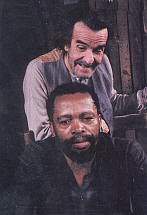
Fugard says this was
the first play in which he discovered
his voice. It was his first international success with
Zakes Mokae (left) and Fugard (right) playing the two roles in 1961 in
Johannesburg. The play (The Blood Knot) originally ran for 3-4 hours
though the rewrite (renamed Blood Knot) brought it to a manageable size. A
blood knot is a fishing knot to join two separate ropes, but the knot in the
play is the two characters' common blood.
Two brothers, both are
ethnically black but one could pass for white. The
"white" one has written a letter to a white
girl who will visit him. Gradually the fear of her visit
takes over. The two are a metaphor for South Africa and
the separate races. Funniest line is when
Morris gets to read his favourite passage from the bible: "Bed time. My turn to chose the
reading tonight. Matthew. I like Matthew. And Asa begat
Josephat, and Josephat begat Joram, and Joram begat
Ozias, and Ozias begat Joatham, and Joatham begat Achaz,
and Achgaz begat…".
"... Blood Knot
sometimes echoes with echoes, and speaks in the voices of Genet,
Pinter and even the John Steinbeck of Of Mice and Men. But
Atholl (sic) Fugard, a white South African, shuns preachments and never
overestimates the human equation. His symbols are the kind that
laugh, cry and bleed" (from In The Prison of Color, Time Magazinem 13
March 1964).
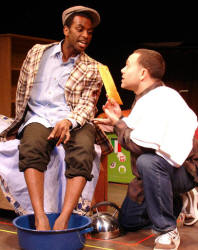
Chris Edwards and Leopold Lowe in Patricia R. Floyd version for Stamford
Theatre Works
The rewrite consists of
small topical updates ("How much does that cost/ Two
and six" becomes "How much does that cost/
twenty five cents") but the major change is the
cutting of almost all monologues, considerably reducing
the running time and moving the dynamics of the play
towards dialogue. Fugard says
"it was in this room late at night that the sight of my
brother...who was fast asleep in the bed, gave me the seminal
image for The Bloodknot" (sic).
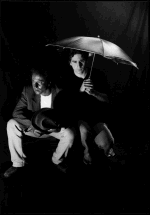
Blood Knot as performed in Iran, looking
very much like Beckett. Thanks to Iman Afsharian for the photo.
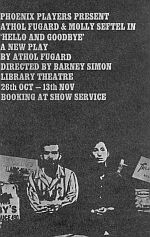
"No change...I'm a fraction older"
"You don't recognise me at all? / I admit I haven't had
a really good look yet. I start with the feet and work up"
Hello and Goodbye from 1965.
Johnnie is alone on stage
desperately lonely He is surrounded by squalor, like a
junk shop. His
loneliness is disrupted by a woman, Hester his sister who
he hasn't seen for more than a decade. The brother talks of looking after
their crippled and dying father and the Hester wants to
know what happened to the money his father would receive
as compensation when he was injured. There is no money, the father
is actually long dead, and the brother and sister have no
love to share. The sister leaves after her short visit
(hence the title) and Johnnie's real inheritance are the
crutches of his father. A life unfulfilled.
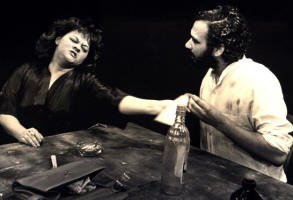
Shaleen Surtie-Richards and Royston Stoffels in the Afrikaans translation
Hallo en Koebaai
Athol Fugard played Johnnie and
Molly Seftel played Hester in the original production in
Johannesburg in 1965. Barney Simon directed. Other actors
playing the roles include Martin Sheen and Ben Kingsley
and Janet Suzman. When Fugard directed in London
in 1974 Bill Flynn and Yvonne Brycleland starred. The room comes from Fugard´s
memories of his mother "my mother was a compulsive hoarder, and all the
rubbish that she hadn't been able to throw away...ended up in cardboard boxes
and suitcases and bags and biscuit tins under beds and on top of already jam
packed wardrobes and chests of drawers." The crutches come from Fugard´s
father "on my last afternoon he hobbled in on his
crutches...his sobbing misery, my tears and the sense of betrayal
and desertion- another pivotal image in Hello and Goodbye"
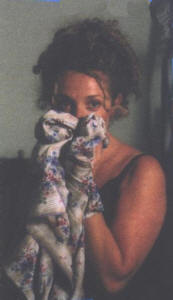
image from Trafalgar Studios programme 2007
"Mr. Fugard takes two not especially remarkable or
unusual characters and by the sheer skill of his writing forces us to take
an interest in them. The play is set in Port Elizabeth, South Africa, but
it could be set anywhere. A young boy has just buried his father-to whom
he was apparently devoted. His solitude is broken by the arrival of his
elder sister, as tough as a husk… It is to Mr. Fugard's credit that we
care about these people, and even worry what will have happened to them by
the final curtain…to be sure they are essentially clichés, the life-stale
floozie who wants a break and the bewildered boy scared to face life,
these we have met before. But Mr. Fugard gives them a revivifying breath
of theatricality, and the actors do the rest" (Clive Barnes, New York
Times, 19 September 1969).
The Last Bus 1969
and Friday's Bread on Monday 1970
The Last Bus is a workshop piece
with John Kani, Winston Ntshona and The Sepent Players. Fugard
directs. In the Notebooks Fugard says "Johnnie and Winston
tried to introduce a psychology, an attitude, the
Ja,
my baas [Yes boss] of the lowest coloured
as opposed to the I am a man
dignity... language a bold mixture of Afrikaans, English and
Xhosa...vivid and real".
Friday's Bread on Monday is
also a workshop piece, again directed by Fugard and with Kani and
Ntshona. There is a lot of mime in this piece. Rob Amato (in
Stephen Gray´s book) says "the impact... left the largely
white audience stunned. Although it dealt with deprivation...it
was not a chry for sympathy. This is where its great strength
lay".
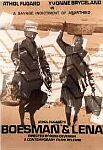
"Ja, thats the way it is.
When I want to cry, you want to laugh"
"In the main, it is a long tale of suffering and despair, of travelling
from place to place as an outcast"
"Leave your bruises on the earth"
Boesman and Lena from 1969.
"Boesmand and Lena exist on the outskirts of civilization, the barren
mudflats of South Africa. It is an emotional wasteland, somewhat akin to
the environment of “Waiting for Godot”—and Atkin Pace's set could also
serve as a place for “Godot.” But unlike Didi and Gogo, Boesman and Lena
are not waiting for deliverance, or even for a messenger. They are already
defeated, ruined by the limits and the repressions of their lives. Their
memories of their life together become a litany of halfforgotten
destinations. The tourney is a treadmill.... As the playwright has
suggested, the characters are each other's fate. They are bound in a tie
as strong as a blood knot. They have shared, suffered and they are
enduring. For all its apparent bleakness, the drama is an uplifting
endorsement of the indomitability of mankind" (Mel Gussow, New York Times,
2 February 1977).
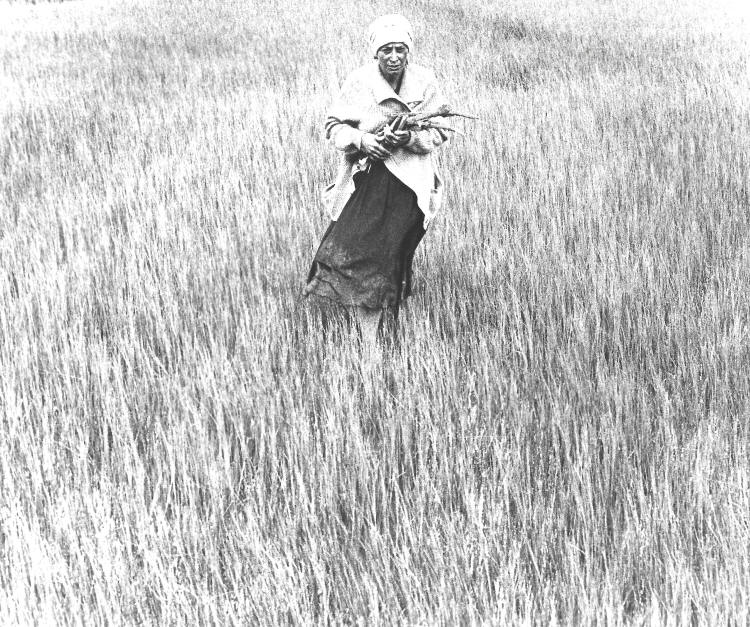
Boesman and Lena are husband and
wife, homeless, so walking with all their possessions. The only
person they meet is the silent Outa, in even worse condition than
they are. But Outa will be a catalyst for Lena. Mary Benson in
Bare
Stage quotes Fugard "I've
dredged up a trio of real derelicts this time. I'm called Boesman, the woman is Lena and the third character
is something of an indeterminate verminous and dying age
called Outa" (Athol Fugard and Barney Simon: Bare Stage, a Few
Props, 1986) Benson says she realised Fugard the
play had its roots in his relationship with his wife
Sheila. Fugard directed the premiere at
Rhodes University with the cast of himself, Yvonne Bryceland and
Glynn Day. He would later direct Zakes Mokae taking over his
role.
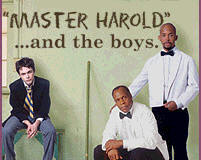
"Right, so much for the
stage directions. Now the characters."
Master Harold...and the Boys from 1982. Based on a childhood
incident Fugard demonstrates the power of apartheid to corrupt. The
boys are the black servants but who is really master and
who the boys? The premiere was in
Yale Theatre America with Fugard directing Danny Glover,
Zakes Mokae and Zeljko Ivanek. Fugard would later direct
John Kani and James Earl Jones in the play. The play was rated number 50 on
the Royal National Theatre's most significant plays of the
twentieth century, equal with Betrayal by Harold Pinter, Blithe
Spirit by Noel Coward and Cloud Nine by Caryl Churchill.
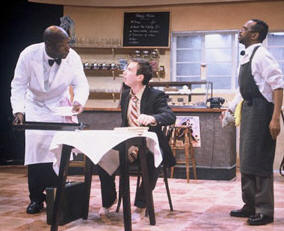
Conrad Kemp, George Seremba and Joe Vera in Bairbre Ni Chaoimh
production for Helix Original
Critic
Richard Gilman
says "Master Harold"... and the boys had a limited run in its
world premiere at the Yale Repertory Theatre, but it is certain to come to
New York City. One hopes that in its reincarnation it will have the
same actors who played Willie and Sam ay Yale. Zakes Mokae as Sam
and Danny Glover as Willie are extraordinarily good: they press for
nothing, underscore no emotions, but ride easily along the swell of the
textual wave or, in keeping with one of the plot elements move like
supremely gifted ballroom dancers. Zeljko Ivanek as Hally and Fugard
in his capacity as director are distinctly inferior to them: Ivanek is
much too brittle, too given to abrupt jagged moments, and Fugard exhibits
an often shaky directorial hand. Nothing fatal here, but there's
room for improvement. (Nation, 1 May 1982, reproduced in The Drama is
Coming Now: The Theatre Criticism of Richard Gilman, Yale University
Press, 2005).
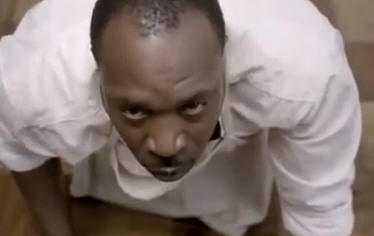
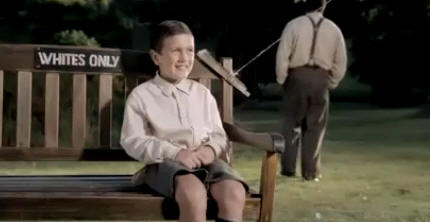
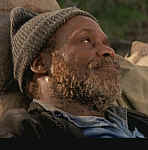
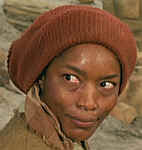
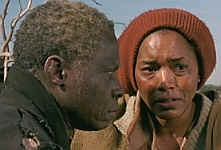
Photos from the 2010 film.
|


