| kvetch
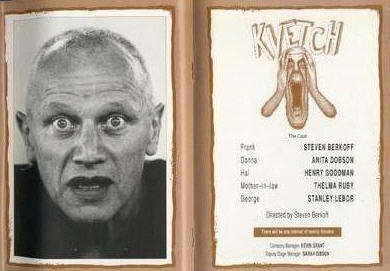
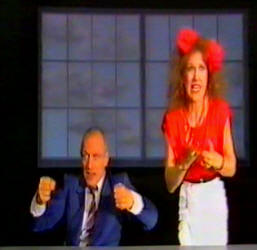
"We all live under the shadow of the bomb". Berkoff´s play to appeal to an American audience failed there, but was successful in Britain. "It's like taking your keys out 10 minutes away from your house." Berkoff´s characters are insecure and speak their inner thoughts as asides to the audience, when the rest of the action is literally suspended, the actors holding their frozen position. There are also a couple of improvisation scenes. A very good play, deep and insightful and like for example the best of Beckett, it is also very funny (see the play to find out why "what else do you do at nights" is so funny and sad).
The
Messiah scenes
from a
crucif
ixion
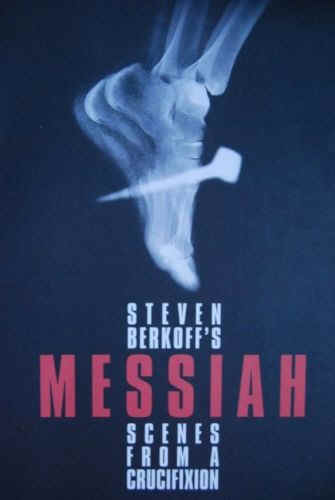
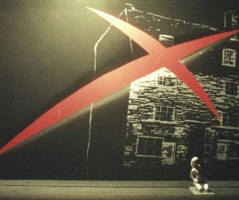
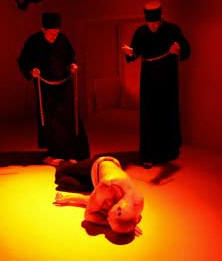
Berkoff wrote The Messiah while directing Metamorphosis in Hebrew in Israel. Years later it was workshopped then premiered at the Edinburgh Festival in 2000. The play is a full two acts with a large cast. It retells the crucifixion, with Christ as a sort of Che Guevara, aware of his political power and also of its limits and seeking a gesture, a faked rising from the dead, to establish himself.
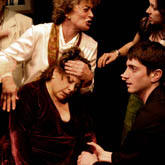
The Messiah has most similarities with the Kafka plays, particularly The Trial, with its use of a chorus and extensive use of mime. The scenery consists of a small podium and a pole used as the cross for the crucifixion. While it is overlong (the speech of Caiphas could be removed), it contains some of the best of Berkoff- Pilate washing his hands of the affair, Satan tempting Christ. And the direction of Berkoff must be the best he has done, Pilate walking backwards, Satan slithering on the ground, the two Pharisees marching. At the Edinburgh Festival Messiah "achieved major newspaper coverage and not least because one night Jesus went missing. Messiah has one of those great but rare openings that can surely only come on a wing and a prayer. This one wins/ The stage is bare. There is silence. Jesus stands. Crucifixion looks imminent. The disciples are behind him, a rigid row of blank faces. One actor becomes a human sculpture. Jesus walks down the line and moulds each body (Tony Jasper & Kenneth Pickering, Jesus Centre Stage, chapter 5, 2010). The book manages to spell Berkoff's name three different ways. When the actor playing Jesus went missing Berkoff took over his role. Also called Impressions of a Crucifixion and The Murder of Jesus Christ Ritual in blood or hep hep hep
Written at the same time as Lunch but only performed recently. "I finished my play which I called Blood Accusation, though at an earlier stage I decided on the odd name Hep, Hep, Hep. This strange cry was purported to have been uttered by the crusading knights as they swept down on the unbelievers... funny what you can pick up at the British Museum". Set in 1255 two children play. One has an accident, falls and dies, the other runs away. The child has died in a Jewish garden and slowly but surely the family, then the entire Jewish population of the town, are caught as victims of anti-Semitism and greed leading to their deaths. All in all the play is good, but suffers in comparison with Arthur Miller's The Crucible. The introduction of the king into the story in Act 2 distorts the play, making it less personal.
Sit and Shiver
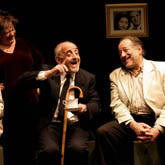
Berkoff wrote the original Sit and Shiver a long time ago but never used it. Still with doubts he decided to update and present it. The premiere was in the Odyssey Theatre, Los Angeles on 27 March 2004 and the British premiere in the New End Theatre, Hampstead, London in June 2006. In the Hampstead version the Lear speech was given in Yiddish. A father has died and the family mourn for him, as part of the Jewish Sitting Shivah rite. Hence the title, a pun, Sit and Shiver "it's Shivah, the Hebrew for 'seven', and so for seven days you sit, shivah, mourn and sit on boxes so that you should be humble and remember the person who has passed away". The first half of the play is a comedy with the guests arriving. At the end of the first act a different guest arrives- one who has a secret.
Site visitor Kari says (thanks Kari): "I loved it, more than I thought I would, and the audience seemed to as well. It got a horrible lack of publicity, one sort of good review and at least one AWFUL one... All the cast were superb apart from one actor who was good, just not great and had the weakest part anyhow. There were a few Kvetch-like movement moments, could have done with more, and the move of the setting from London to New York worked very well. In fact it's better suited to America, and Steven cleverly worked in the story of the Brooklyn Bridge (remember he did that docu-drama? He became an expert on its history!). I think the audience (on the old side) weren't so taken with the bodily functions talk, but they laughed loudly at all the stuff about cooking..." Biblical Tales
Four short plays, retelling stories from the bible: Adam & Eve, Samson & Delilah, David & Goliath and Moses & Pharaoh. 2010. In Delinquent Berkoff says as a child "I loved the stories of our past: of Abraham and Isaac, Jacob, Joseph and his coat of many colours, the exodus from Egypt".
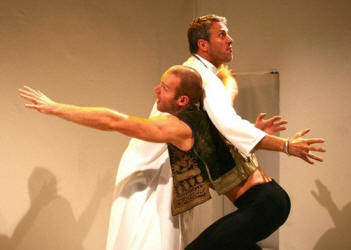
Matthew Clancy and Mark Frost as Pharaoh And Moses, New End Theater, London, 2010. Click on the image for the source. Religion & Anarchy
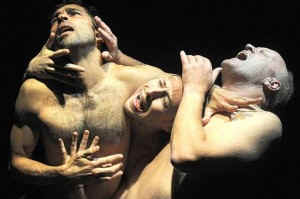
Five short plays about Jews and the holocaust. The plays are Guilt, Roast, Line-Up, How to Train an Anti-Semite and Gas. Guilt is under 20 pages with middle aged Jewish husband and wife Henry and Polly. The plays feature some Yiddish words: ayeyai Roast Line-Up is a seven page two hander. A and B are in the line-up in a concentration camp. Ahead people are sent by Nazi officers to the left or the right. One direction means death. Yiddish words: alta cucker meaning old man and shmock meaning idiot. How to Train an Anti-Semite is a 12 page two hander featuring Dot and Sid. English slang: wadja is would you, outta is out of, wossat is what is that, yourra is you are a, bung a bit of dosh is give some money, wiv is with, Gas is under three pages with A, B and C in the gas chamber of a concentration camp. Yiddish words: the prayer Shema Yisroel, Adone Elahaynu, Adoni echod meaning Hear Israel, the Lord is our God, the Lord is One; boobala, kindala and popa meaning dearest, children, father.
|