|
Adaptations of novels or stories often suffer in a different media, and adaptations of famous works suffer from over-reverence. Compare the tame filming of the novels of Graham Greene with the film script written by Greene himself (The Third Man). Like Greene, Berkoff understands the essence of the story and the power of the medium. Berkoff´s adaptations and direction are spectacular theatre. 1974 The Fall of the House of Usher
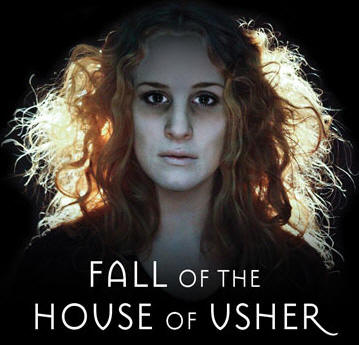
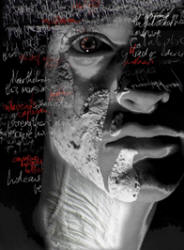
I look on him with horror. He has altered beyond belief. Are you the same person that I once knew. Cadaverous expression. Ghastly palor of skin, eyes luminous beyond comparison yet sunken in two dark sockets. Your hair, once so long and fine now clings with lifeless form about your head. You smile, You smile and I cannot recognise the monster which hides behind your teeth. You have altered beyond belief. Poe's most famous story. Berkoff says it is "about energy twisted in upon itself. It is about the refined last stages of obsessive madness". The playbooks includes a commentary of the entire play "he reaches up and tears down a dripping silken fabric which could have previously suggested the fabrics of the house and now becomes both an image of her winding sheet and soft cocoon as if the bed had come to her and she spins around this until mumified (sic)". Berkoff quoted from playbook. Poster above from Torn Space Theater in Buffalo NY . Photo below from Homerton Amateur Theatrical Society, Cambridge.
1981 The Tell-Tale Heart Object there was none. Passion there was none
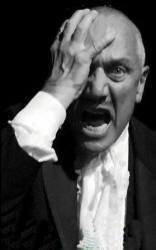
A solo piece performed along with Pitbull and Actor. Poe's tale is a psychological monologue of a murderer confronted with the police. This isn't an adaptation but a performed reading of the original piece. You can read the text here. In Delinquent Berkoff says as a child he listened to a weekly radio thriller which "always started with... the sound of a door slowly opening with a long menacing creak to put you in the mood". In performance Berkoff savours Poe's line "I turned the latch of his door and opened it- oh so gently!", savouring the noise of the door opening. 1973 Miss Julie versus Expressionism Berkoff adapts Strindberg´s Miss Julie. Berkoff states in Free Association "I had to work out a new piece of theatre. Why I decided on Julie I don't quite know, except that I thought it would be a good double act for Maggie Jordan and myself... we were getting nowhere fast since I was congenitally incapable of doing it for real, with a real table and chairs and pots and pans... I changed the order of events, much like a collage, and pieced together themes of the play so that one scene collided into another, much as if you were watching a series of trailers for a film". 1971 Agamemnon
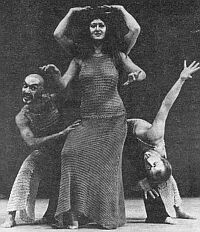
Blood will have blood/ The high will fall/ the ghosts of men who died for nothing/ will walk and wail by a ruined wall Berkoff´s adaptation of Aeschylus' Greek drama. Berkoff says "these plays (Agamemnon and Usher) were written to exorcise certain demons struggling within me to escape. Agamemnon is filtered through my own impressions of Greece and is rooted in the elements of landscape, and sea... It is about heat and battle, fatigue, the marathon and the obscenity of modern and future wars". Photo Roger Morton from Theatre, Berkoff quote from Theatre. Oedipus
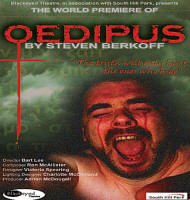
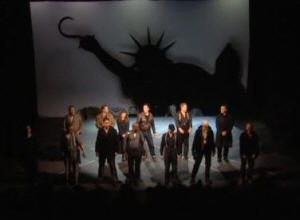
be a king of men not of ghosts Berkoff´s adaptation of Sophocles´ play Oedipus. The country is barren and Oedipus the king learns that the devastation is caused by the murder of King Laius. He must seek out the murderer to save the country. But the curse goes further and Oedipus finds himself drawn down into horrors he cannot bear to see. Unwittingly he breaks taboo after taboo and incurs the wrath of the gods, the same gods who laid out his path to destruction. The adaptation is clear, similar to the Pasolini film version. Published in 2000, Blackeyed Theatre premiered a production of the piece in 2008 at the South Hill Park Arts Centre, Bracknell. The image below is from this production. In 2011 Berkoff premiered the his professional production.
On the Waterfront
Uwittingly implicated in Joey's murder, Terry starts to question where his loyalties lie. When he falls for the dead man’s beautiful sister, he enlists the help of the street-wise Father Barry to bring down the racketeers. The classic story of the guy who ‘coulda been a contender', On the Waterfront is best known for Elia Kazan's multi-Oscar winning film, starring Marlon Brando. Berkoff adapts the famous film for the stage, with a minimal staging (chairs and a backdrop) and lots of mime. |